1939: New Vicar of Beddgelert

posted in: Newspapers | 0

The Rev. G. B. Walmsley, curate of Llandudno, and formerly curate of Menai Bridge, has been appointed vicar of Beddgelert, in succession to the late Rev. John Jenkins.

The Rev. G. B. Walmsley, who is a native of Four Crosses, near Pwllheli, is a graduate of Leeds University.

Published by Liverpool Evening Express, 5 September 1939

FacebooktwitterpinterestmailFacebooktwitterpinterestmail

1939: Death of the Rev. John Jenkins

posted in: Newspapers, Obituaries | 0
Vicar of Beddgelert – Death of the Rev. John Jenkins

rev john jenkins death 1939

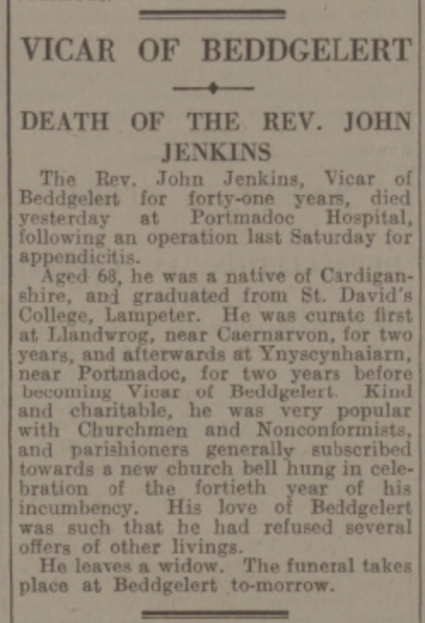
The Rev. John Jenkins, Vicar of Beddgelert for forty-one years, died yesterday at Portmadoc Hospital, following an operation last Saturday for appendicitis.

Aged 68, he was a native of Cardiganshire, and graduated from St. David’s College, Lampeter. He was curate first at Llandwrog, near Caernarvon, for two years, and afterwards at Ynyscynhaiarn, near Portmadoc, for two years before coming Vicar of Beddgelert. Kind and charitable, he was very popular with Churchmen and Nonconformists, and parishioners generally subscribed towards a new church bell hung in celebration of the fortieth year of his incumbency. His love of Beddgelert was such that he had refused several offers of other livings.

He leaves a widow. The funeral takes place at Beddgelert to-morrow.


Source: Liverpool Daily Post, published 4 August 1939

FacebooktwitterpinterestmailFacebooktwitterpinterestmail

1926: Chapel roof blown away

posted in: Nantmor, Newspapers | 0

Shortly after a service at Nantmor Methodist Chapel, near Portmadoc, on Wednesday night, the entire slated roof of the chapel, including the rafters, was blown away, the greater portion dropping on the roofs of three houses 60 yards away and smashing the roofs and windows.  Fortunately no one was hurt, but the damaged houses had to be vacated.

The Times, 1 January 1926

FacebooktwitterpinterestmailFacebooktwitterpinterestmail

1921: Grant to poet

posted in: Nantmor, Newspapers | 0

The Prime Minister has obtained a grant of £100 from the Royal Bounty Fund to Mr. G. Williams (Carneddog), a Welsh farmer and poet who lives at Nantmor, a small village at the foot of Snowdon, in recognition of his services to Welsh literature and poetry.

Published by Hartlepool Northern Daily Mail, 14 June 1921

FacebooktwitterpinterestmailFacebooktwitterpinterestmail

1919: Beddgelert War Memorial

posted in: Newspapers, WW1 | 0

A generous offer

Beddgelert War Memorial

Mr. W. R. Williams, chairman of Beddgelert Parish Council has received a letter as follows from Mr. J B. Heywood, Manchester

We presume that in common with other patriotic localities you are erecting some kind of memorial to the men of your district who fought and fell in the great war.

We have a suggestion to make, which, we hope, will meet with your approval, for a memorial which would fill a dual purpose and remove a reproach, if we may say so, to your town.

The writer remembers being taken to Beddgelert many years ago, and being greatly disappointed at being shown a tree with railings round it, which was pointed out as “Gelert’s Grave,” having expected to see as described in Spencer‘s poem— A gallant tomb with costly sculpture decked.”

To be brief, our suggestion is that, somewhat late in the day, a “gallant tomb” should be erected and combined with a War Memorial. We suggest that a Welsh sculptor should be employed and local material used, and if we may be allowed, we shall be very glad to subscribe in a suitable manner. We suggest that if the interest of the Premier could be obtained the scheme would be as good as successfully concluded, and we have little doubt that considerable benefit would accrue to the town of Beddgelert from this long-delayed act of justice.

The Cambrian News and Merionethshire Standard, 8 August 1919

FacebooktwitterpinterestmailFacebooktwitterpinterestmail

1916: A Beddgelert Soldier’s Letter

posted in: Newspapers, WW1 | 0

First Night Under Fire.

A BEDDGELERT SOLDIER’S LETTER.

Private Bob Thomas late of Cwmcloch, Beddgelert, in a letter to a friend dated October 31st from France, says: –

“ I have been over here about six weeks now. I can’t say I enjoy it; but I don’t grumble. It’s good to see a bit of the world and to see what war is like. I always wanted to come out here, but I must confess there have been moments when I felt sorry I have had to come. I have now an idea of what war is like.

The first day I went into the firing line Fritz gave us a lively time. I shall never forget that first day. It was a Sunday. When we got within range of the German guns I was a bit nervous, especially when the shells dropped around us in the trenches. I kept my eye on an old soldier and soon found out what was the best thing to do. I soon found the truth of the old proverb “Example is better than precept. ‘

Next day, about five p.m., Fritz started shelling again, and I thought my time was up. If somebody was to tell me before I came out here that things are as terrible as they actually are out here I would never have believed them. It simply rained shells that night. Thank God for that old soldier who stood near me. He heartened one as he stood there like a statue, never moving only to dodge the shells.

My courage nearly failed me that night; but that old soldier standing near me helped me to stand firm and copy his example. Well, Fritz got tired of it in about half an hour. I expect he thought we were all dead. We came off with surprisingly few casualties. I was none the worse, only half buried twice. A piece of shrapnel went through my steel helmet, but it did not hurt me; its force was checked.”


Source: The Cambrian News and Merionethshire Standard, published 1 December 1916FacebooktwitterpinterestmailFacebooktwitterpinterestmail

1916: Saved by a Gift

posted in: Newspapers, WW1 | 0

Private Griffith Pritchard Davies, Beddgelert, of the Lancashire Fusiliers, was saved from death by his cigarette case during the offensive in France. A piece of shrapnel rebounded from the case, taking part of his arm away. The case was presented to him by a Beddgelert friend when the soldier was home at Whitsun, and Davies, in accepting the gift, jocularly remarked, “Perhaps this will save my life.”

Private Evan Harris, Borthygest, Portmadoc, of the Welsh Fusiliers, and Private David John Williams, Beddgelert, of the Liverpool “Pals” have been killed in action, and Regimental Sergeant-Major Simms, Portmadoc, of the Welsh Fusiliers, has been dangerously wounded.

Published by Liverpool Echo, 15 July 1916FacebooktwitterpinterestmailFacebooktwitterpinterestmail

1914: Snowdon Ranger Hotel – now a home of rest

posted in: Newspapers | 0

SNOWDON RANGER HOTEL.

NOW A HOME OF REST.

This well-known house, formerly an hotel, has been transformed into a home of rest for missionaries.

It will be the property of the society of the Sacred Mission, which is a Church of England community of men, and of which the Bishop of Southwell is Visitor. The society, which is engaged in several foreign missions and is also working in English parishes, has its chief house at Kelham Hall, between Newark and Southwell, where there is a theological college and a large staff of tutors. Many of the students have no private means, and the society undertakes the whole responsibility of their education.

It is the intention of the society, it appears, to use the Snowdon Ranger as a house of rest and a holiday resort for their missionaries from abroad, for tutors during holidays, and for any students who may need a change of air. Occasionally also a large number of visitors may be entertained there. Kelham Hall is now so full that the society has for some time desired an additional house which may serve as an overflow house for the clergy. There is no intention at present of building a chapel, but should the house become uncomfortably full such an addition might prove to be necessary. The college has had more than 90 men ordained, including a few Welshmen. The licence of the hotel was recently allowed to lapse, no application for its renewal being made at the last licensing session. It is situated in one of the most romantic spots in Wales.

North Wales Chronicle, 14 May 1914

FacebooktwitterpinterestmailFacebooktwitterpinterestmail

1910: Rhyd-Ddu – Lecture

posted in: Newspapers, Rhyd-Ddu | 0

In the Literary and Debating Society of the above place held last Tuesday evening, a lecture was delivered by Mr T. H. Parry-Williams, B.A., Oxford, a native of the place. His subject was “Ieuenctid y Dydd,” and he dealt with the young Welsh poets that have lately published their works. The lecturer criticised and eulogised the works of Eifion Wyn, Emyr, Moelwyn, W. Wyn Williams, Silyn, and W. J. Griffith, in a very keen and masterful manner, and recited most effectively specimens from the lyrics of each poet. Though much had been written to the contrary, from time to time, he considered the present age, so far, the golden age of Welsh poetry. The interest of the audience was kept without flagging from beginning to end by the many and varied recitations the lecturer gave from the poets under consideration

Published in Carnavon and Denbigh Herald, 14 January 1910FacebooktwitterpinterestmailFacebooktwitterpinterestmail

1909: Heavy Fine for Dynamiting a Salmon River

posted in: Newspapers | 0

John William Jones and Robert Pierce, Beddgelert, the latter in service with Jones’s mother, at Portmadoc admitted using dynamite to destroy fish in the Glaslyn, the chief salmon river of Snowdonia. A water bailliff, who was in hiding for several hours, caught them dynamiting a pool in which two salmon had been seen. The salmon, however, escaped before the explosion. Jones was fined £7 10s with 32 6d costs, and Pierce 10s 6d witthout costs.

Published by Western Times, 13 September 1909FacebooktwitterpinterestmailFacebooktwitterpinterestmail