Main Menu | A to Z of Aldeburgh Places & Properties
Belstead House School was founded in Aldeburgh in 1906 by Mrs. Griselda Mary Theophila Hervey neé Campbell (1869-1929), then 37 years old, and her husband, Mr. Dudley Francis Amelius Hervey (1849-1911), 20 years her senior, who lived at Westfield. Mrs. Hervey had been educated at Belstead (near Ipswich) and Westfield (in Hampstead).

Belstead House, pictured above, was built as a pair of semi-detached houses in Marsh Lane (now 53 and 51 Park Road) and is circled on the 1903 map below.
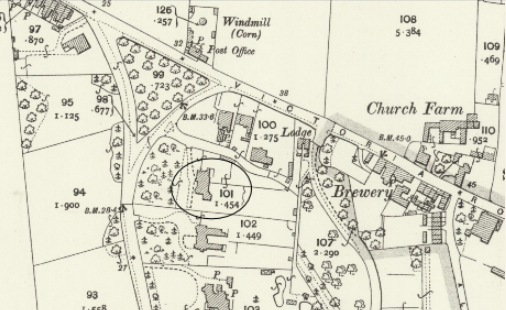
In Autumn 1906 there were just seven girls, and by Spring 1911 this had grown to seventeen girls.
As its reputation was established, pupil numbers increased and the school site expanded over time to accommodate them (as circled on the 1926 map below right).

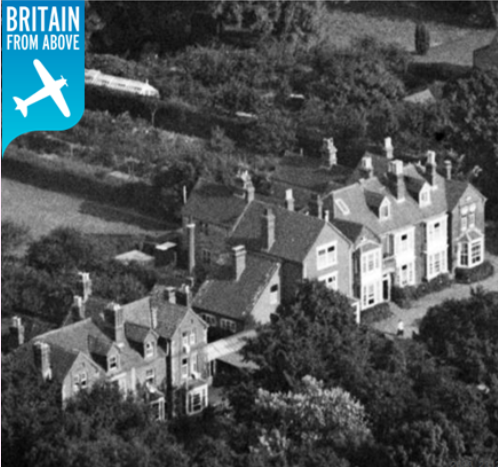
The adjacent pair of semi-detached properties (now 47 and 45 Park Road) were added and a detached property (now 49 Park Road) was built between them with covered walkways. In addition a gymnasium and school chapel* were added.
The school even expanded to include a Domestic Science branch at Alde House.
The photograph (right) shows Belstead House School in 1920, with number 45 Park Road far right and number 53 Park Road far left.
Mrs. Hervey was headmistress until her death in 1929.
MRS. DUDLEY HERVEY – A GREAT SCHOOLMISTRESS

The news of the death of Mrs. Dudley Hervey, of Belstead House School, Aldeburgh, will be the cause of deep sorrow to her large circle of relations and friends and to the many women and girls to whose early training she devoted 23 years of her life. She had been seriously ill for some time past, and on Monday afternoon passed quietly and painlessly away. The immediate cause of her death was heart failure, to a large extent brought on by the untiring activity with which she spent herself on every detail or her many-sided work.
Mrs. Hervey, who was the youngest sister of Lieutenant-Colonel Sir Guy Campbell, was educated at Belstead, Ipswich and Westfield College, Hampstead. Soon after leaving Westfield she married Mr. Dudley Francis Amelius Hervey, C.M.G., son of the Rev. Lord Charles Hervey, and for many years a valued member of the Colonial Service in the Straits Settlements, where he was Resident Councillor of Malacca from 1882 to 1893, and a member of the Executive and Legislative councils of the Colony. In 1906, while her husband was still alive, she started her school at Aldeburgh with a complement of only seven girls. But, thanks to her broadminded views on education and the charm and influence of her remarkable personality, it soon made a name for itself, so that as time went on, even after she had extended her borders and had added to it a school of domestic economy for older girls in a separate building, it was sometimes impossible to find room for all the girls whose parents were anxious to place them under her care.
In her system of education, which necessarily included all the regular subjects required for the passing of university and other examinations, she attached particular importance to the sound teaching of French and, in one form or another, of music. As a friend of Cecil Sharp, she was a strong believer in the educational value of folk songs and dances, and more than once during the school holidays invited him and the numerous members of his Summer Festival School to make use of Belstead and her other houses as their headquarters. Before they left school many of her own girls were qualified instructors in both forms of the art which Sharp revived, and it was characteristic of Mrs. Hervey (herself a Deputy Commissioner of Girl Guides) that she used to allow the picked singers and dancers of the school and the senior members of the Belstead Company of Girl Guides and Sea Scouts to go out into the country around Aldeburgh and help the village girls to form classes and companies of their own. For, above everything else, what she tried to do with the girls in her school was to train them to be useful and helpful members of society, good daughters, good wives, good mothers, good workers, whatever sphere of life they might be called upon as women to fill. The secret of her success – for that she did wonderfully succeed every one who knew and understood her aims and the ton e of her school will testify – lay first of all in her own character and the living example of a high standard that she set to the girls in her charge. Her care for their bodily welfare was illustrated by the fact that she was one of the first people in this country to establish a “clean milk” dairy for the use of her school. Their spiritual training she kept almost entirely in her own hands. She was very proud of her profession and its place in the world, but humble and diffident almost to a fault in her view of the part which she herself played in it. Like all great schoolmistresses she loved greatly and was greatly loved by her girls. That was the foundation on which the whole of her teaching – intellectual, moral, and spiritual – was built. Each of the children committed to her care was to her a scared and separate trust, to be studied and helped and loved as an individual soul. Because of what she was to them, even when she fell short of her own standard, her influence will have a lasting effect on the lives of all those, including her son Dudley and her daughter Griselda, to whom she devoted her own. The funeral will be at Aldeburgh on Saturday, at 2.30.
The Times, 3 April 1929.
“BEST SON AND DAUGHTER”
Mrs. Griselda Mary T. Hervey, of Belstead House School, Aldeburgh, who left unsettled property valued at £32,710 gross, bequeathed all her property to her two children, saying: “And I leave them my blessing as the best son and the best daughter that any one could be given.”
Yorkshire Post, 1 July 1929
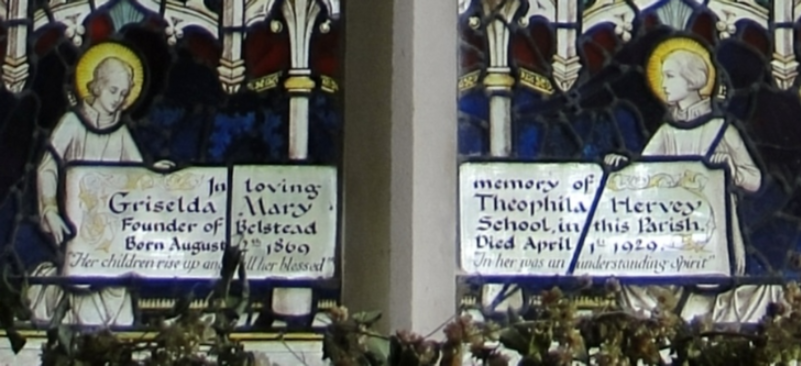
In loving memory of
Griselda Mary Theophila Hervey
Founder of Belstead School, in this Parish.
Born August 12th 1869 Died April 1st 1929
“Her children rise up and call her blessed”
“In her was an understanding spirit.”
After Mrs Hervey’s death, one of her sisters took charge for a few years. Miss Ethel Tirzah Barnes (1891-1957) was headmistress from 1933 until the beginning of World War 2. The school moved to Thoby Priory, Mountnessing, Essex in 1940 for the ‘war period’.

*The wooden school chapel at Aldeburgh was subsequently resited next to Aldeburgh Parish Church as the present Church Hall and a brick entrance lobby was subsequently added.
A to Z of Aldeburgh Places & Properties
Page last updated: 24 November 2024